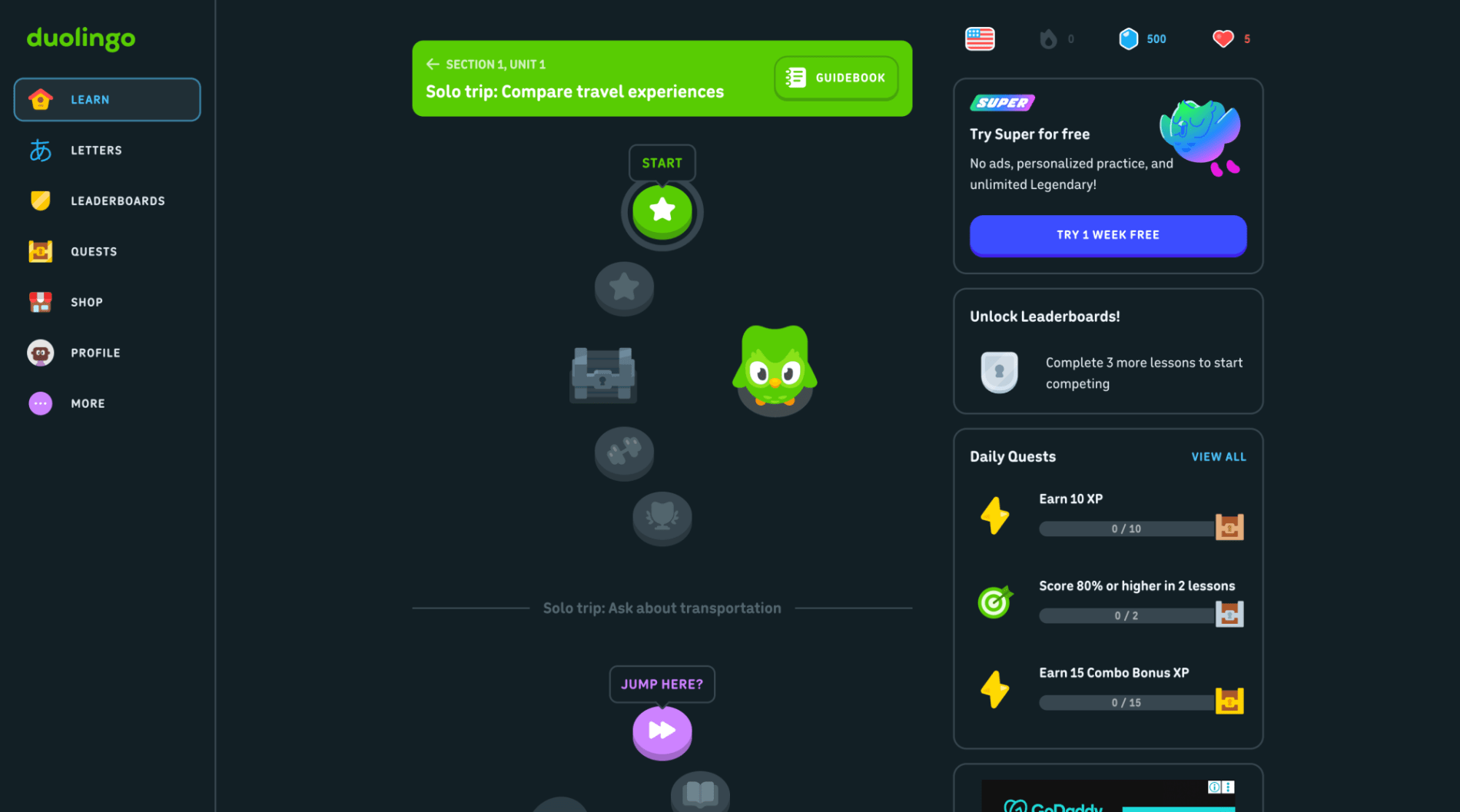
This is Duolingo's main learning path screen, where users navigate their language course progression. The vertical path shows a sequence of lessons and checkpoints, with the current lesson 'Solo trip: Compare travel experiences' prominently displayed at the top. The screen serves as both a progress tracker and the primary navigation hub for all learning activities, showing locked and unlocked content, upcoming lessons, and the user's position within the curriculum.
Goal Gradient Effect
Motivation & Engagement
- The entire screen architecture is built around making progress visible and imminent.
- The bright green START button sits at the current position, with grayed-out future lessons below creating a clear visual trajectory.
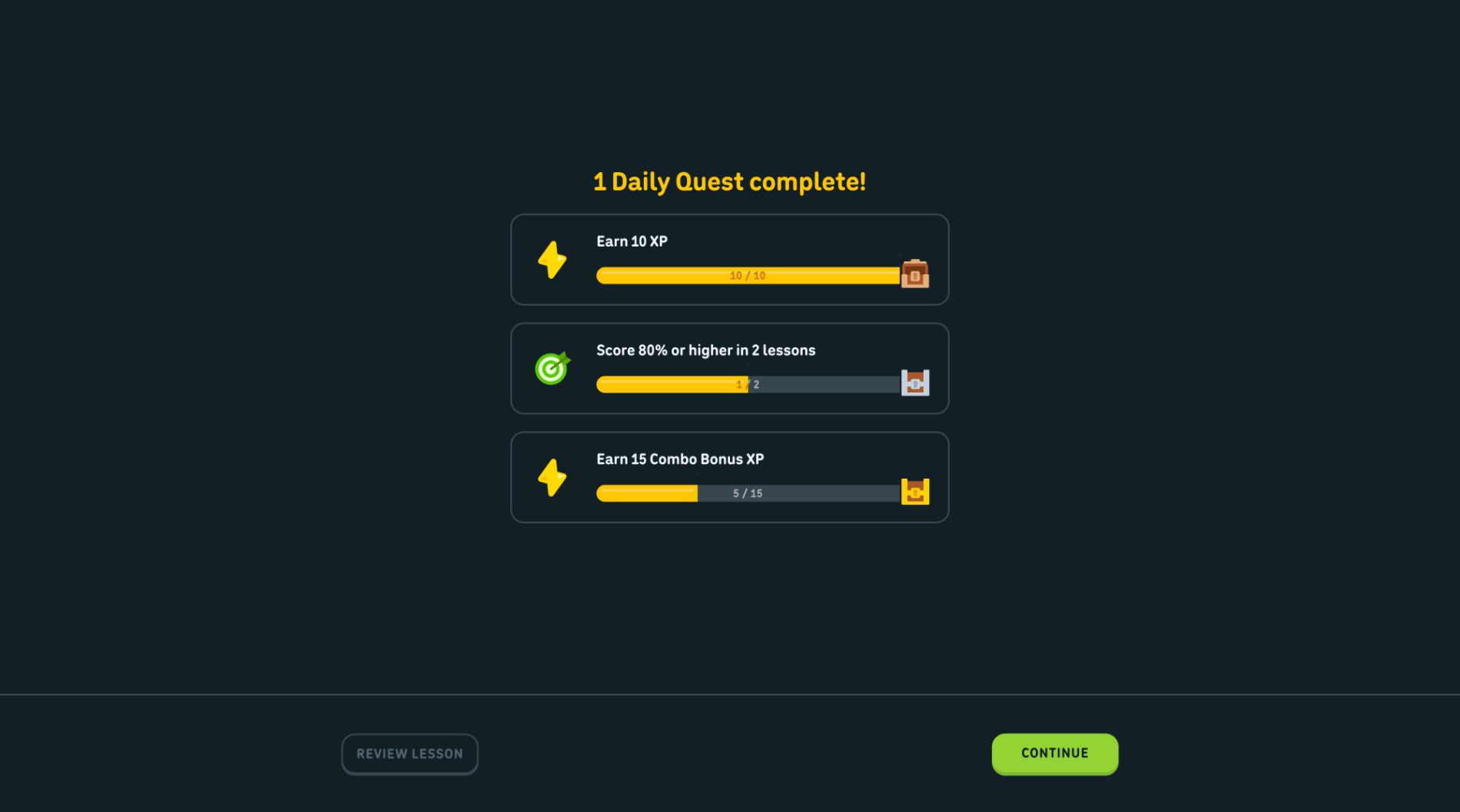
- The Daily Quests panel reinforces this with three parallel progress bars all starting at zero, creating multiple concurrent goal gradients.
- This design exploits the psychological reality that motivation increases as you approach completion — by showing exactly where you are and how close the next milestone is, the screen makes starting feel like continuing rather than beginning.
- The vertical lesson path with the green START button at top, followed by locked gray circles below, and progress bars in the Daily Quests panel showing 0/10, 0/2, 0/15
- Every element on screen — from the vertical path to the three simultaneous progress trackers — is calibrated to show proximity to completion, creating compounding motivation through multiple concurrent goal gradients.
Progressive Disclosure
Cognitive Load & Information Processing
Variable Reward
Motivation & Engagement
MotiveThe user opened Duolingo to continue their language learning session, either returning to daily practice or following a notification prompt. They landed here because this is the app's home screen — the default destination after launch.
ObjectiveResume language learning by starting the next available lesson in their learning path.
MindsetExecutingReturning
Insight- Multiple simultaneous progress trackers create more motivation than a single linear path, but only if they converge on the same action.
- Duolingo's genius is that all three daily quests are completable through the same green START button — the quests aren't alternative goals, they're parallel scorecards for the same activity.
- This pattern works because the split attention is perceptual (seeing multiple progress bars) while the actual behavior remains unified (do the lesson).
- The moment those progress bars require divergent actions, the motivation multiplier becomes a distraction tax.
Tension- By showing multiple simultaneous progress bars (lesson path + three daily quests), the screen maximizes motivation through concurrent goal gradients, but risks splitting user attention across four different completion targets.
- A user might complete a quest without advancing the main path, or advance the path without completing quests, creating potential for misaligned effort and diluted satisfaction.
- The cost of compounding motivation is fragmented focus.
learning pathprogressionquest systemfreemium conversiondaily goals